

The Hospitality Landscape Is Changing: A Market That Is Maturing and Demands Strategy
Why the next chapter will not be defined by volume, but by the value each property creates
The Founder & CEO of Axia Hospitality, Giannis Kyritsis, speaks about the transition of the Greek hospitality market toward high-performance strategies, the need for differentiation, and the role of Artificial Intelligence in shaping the hospitality of tomorrow.
Axia Hospitality has established itself as one of the leading hotel management groups in Greece. What are your next steps?
Axia Hospitality is the company that introduced a professional mindset around sales and reservations management in Greece. We were among the first to recognize that hospitality, in order to become a true business driver, requires data, strategy, and methodical execution — not just experience and intuition. In a traditionally operated market, we introduced revenue thinking, forecasting, commercial logic, and clear performance targets.
The next chapter of Axia Hospitality is built on three constants: quality control, selective growth, and product creation with a clear identity. We are not focused on volume; we focus on value. Our goal is for every new asset that joins our portfolio to earn its place in the market — not simply to operate.
The past season closed with record tourism numbers but also high operating costs. How did your portfolio perform in this environment?
This season was among the most complex and interesting of recent years. Demand reached historic highs, yet rising operating costs and pricing pressure brought the market to a point where professional management is required — not just basic operation. The overall picture was mixed. While Greece recorded historically high arrivals, Mykonos and Santorini, two of the country’s most mature and premium destinations, experienced pressure.
In these markets, our objective was not to chase overperformance in a year showing signs of fatigue. It was to protect revenue, keep ADR as stable as possible, control yield, and limit value leakage.
How do you leverage your collaboration with Eurobank in terms of financing and investment tools for hoteliers?
For us, our collaboration with Eurobank is part of a broader ecosystem designed so that investors do not need to seek fragmented solutions. Axia has evolved from an operator into a value shaper. We build product, define identity, design operational models, and develop commercial strategy — and within this chain, financing supports what already makes sense, rather than trying to fix things retroactively.
The ecosystem we have created functions as an investment maturity platform. Hoteliers do not come to us simply for management; they come to build a product from scratch or to upgrade an existing asset in a way that is economically sound and commercially sustainable. This is where our work aligns with Eurobank. Investors approach financing not with a vision on paper, but with a fully developed strategic positioning, market analysis, operational plan, and realistic revenue forecast.
International hotel chains are strengthening their presence in Greece. How does Axia maintain its competitive advantage?
Competition from international brands is a given — and to a large extent, welcome. It signals that Greece is no longer viewed as a peripheral market but as a strategic destination. However, this also raises the bar.
For a Greek hotel management group to remain relevant, it is not enough to simply “run” hotels. It must offer owners something that global chains cannot easily provide: flexibility, alignment with the destination’s DNA, deep understanding of the local product, and genuine participation in business risk.
Which regions or types of accommodation are you targeting for expansion?
Our focus is on destinations with genuine potential for product differentiation, not merely geographic appeal. Island destinations capable of delivering premium experiences, mountain destinations with a strong identity, and new boutique hospitality models are core areas of interest for us.
How do you see the role of Artificial Intelligence in the future of hospitality? What are you preparing?
Artificial Intelligence is fundamentally changing how decisions are made in hospitality. Until recently, the sector relied mainly on experiential judgment and historical data. Today, we can forecast demand, dynamically adjust pricing, monitor booking performance in real time, and control commercial efficiency with a level of accuracy that was not possible just a few years ago.
At the same time, we are developing AI systems that support the operational side of reservations in a smarter and more efficient way. Our goal is to automate a significant part of daily booking flows — from identifying opportunities to managing changes and cancellations — allowing hoteliers to gain time, precision, and control. Technology handles the repetitive tasks, while the team focuses on strategy and guest experience.
The country’s capacity appears to be approaching its limits. What do you foresee for the future?
I believe the major challenge of the next decade will be differentiation and upgrade. Mykonos and Santorini already demonstrate this — it is not about arrivals, but about added value, experience, and margin management. The market does not need another hotel; it needs hotels with a clear purpose, strong positioning, and experiences that justify their pricing. Those who continue to “sell accommodation” alone will be pressured. Those who offer experience will endure.
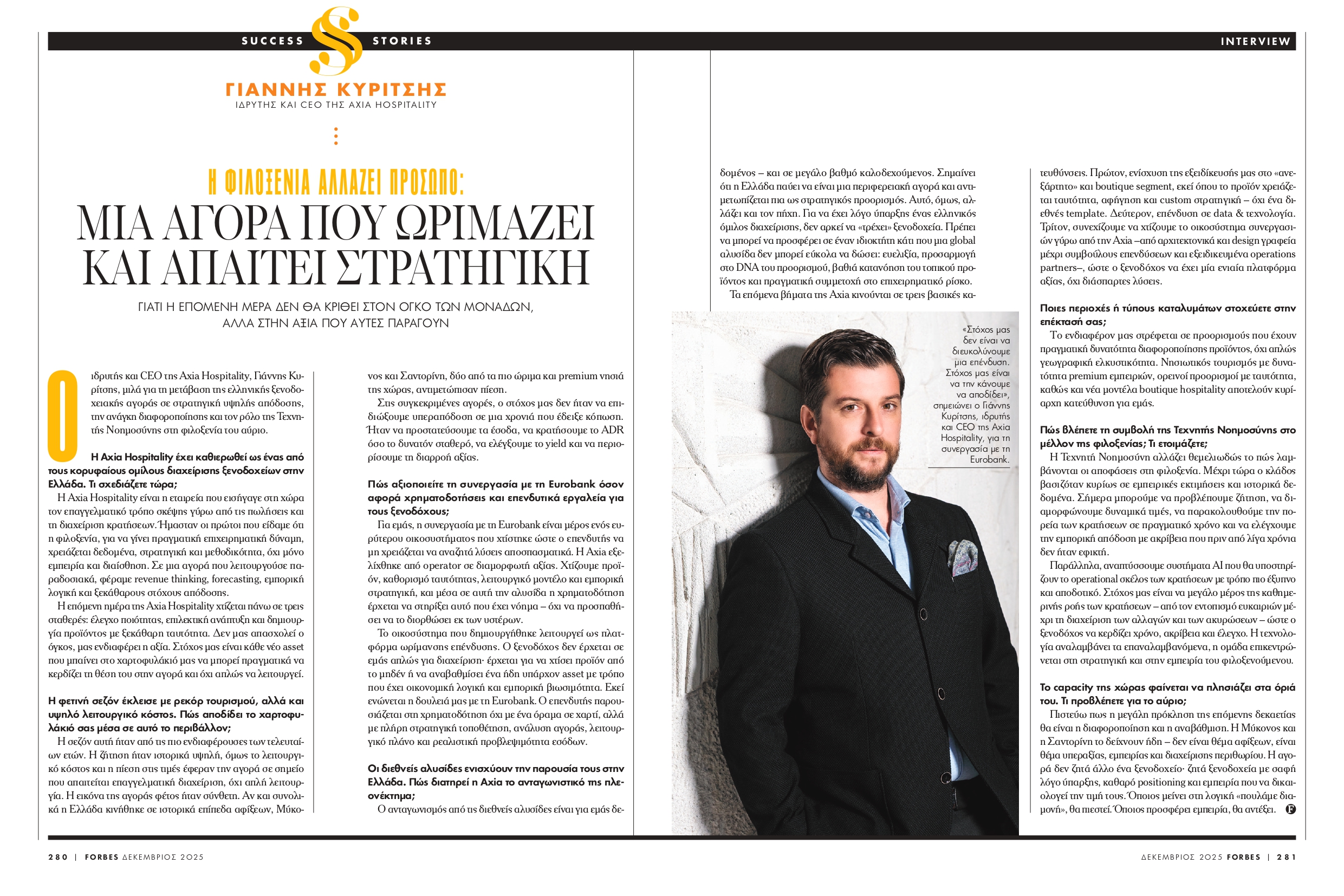
“Our goal is not to facilitate an investment. Our goal is to make it perform.”
Source: Interview as published in Business Stories (Axia Hospitality), Forbes December 2025.
